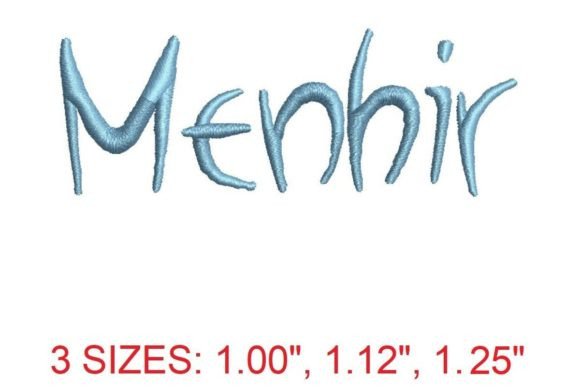
Menhir Embroidery Font
A Bold Choice for Craft Fair Success
The Menhir Embroidery Font makes a strong first impression. With its strong and robust letterforms, it feels like a powerful statement piece. It's not the kind of font you'd use for a delicate floral design—it’s more about impact than subtlety. This font exudes a modern, rustic vibe that’s perfect for craft fairs and handmade markets where boldness often wins over finesse.
Where Does Menhir Excel?
When considering what products best showcase the Menhir Embroidery Font, several stand out. Tote bags, aprons, and tea towels are natural choices due to their large surface areas. These items give the font room to breathe and make a visual impact. The Menhir font also works well on embroidered patches and caps, where its strong lines can be emphasized without being overwhelmed by surrounding details.
For small shop products like fabric pouches and pillow covers, the Menhir font can act as a focal point or a subtle accent. Its versatility allows it to adapt to both large and small formats, making it suitable for a wide range of craft fair products. In terms of Etsy listings and printable mockups, the Menhir font holds up well, offering clear visibility even at smaller sizes when printed properly.
Practical Considerations for Production
From a production standpoint, the Menhir Embroidery Font is relatively straightforward to work with. It doesn’t have dense stitch areas or tiny details that might complicate the embroidery process. However, it does require attention to thread color contrast and stabilizer choice, especially when working with dark fabrics or textured surfaces like towels.
One thing to note is that while the Menhir font performs well on flat surfaces, it may lose some clarity on curved cap surfaces or thick fabric. As an embroidery designer, I recommend testing the design on scrap fabric before committing to a full batch. Checking stitch density and confirming hoop size are also essential steps to ensure consistent results across all finished products.
Design Assets That Matter
When preparing digital embroidery files, the Menhir font offers a good balance between simplicity and visual appeal. It’s ideal for commercial embroidery and digital embroidery files, especially when paired with high-contrast thread colors. The font’s clean lines and strong structure make it easy to read at a glance, which is crucial for attracting customer attention in a busy craft fair environment.
For Etsy sellers and small shop product creators, having a variety of design assets—such as printable mockups and detailed instructions—is key. The Menhir font should be accompanied by clear guidelines on fabric texture compatibility and recommended stabilizers to help customers achieve the best results. Ensuring that the design assets are well-organized and user-friendly can significantly improve the overall customer experience.
Visual Appeal and Brand Consistency
The Menhir Embroidery Font contributes positively to visual appeal and brand consistency. Its bold and impactful nature aligns well with the Back To School theme, offering a fresh and modern look that appeals to both students and educators. When used consistently across multiple products, such as tote bag designs, apron embroidery, and market bags, the Menhir font helps build a cohesive brand identity.
Customers are drawn to products that look good in person and photograph well online. The Menhir font is particularly effective in this regard, as its strong letterforms translate well to both physical displays and digital listings. Whether it’s a handmade product displayed on a booth table or a finished product listed on Etsy, the Menhir font maintains its visual strength and clarity.
Key Notes for Embroidery Designers
As an experienced embroidery designer, I recommend a few key steps before moving forward with the Menhir Embroidery Font. First, test the design on scrap fabric to assess stitch density and thread contrast. Second, review spacing and confirm that the design works well on different fabric textures, including thick materials like towels.
Third, inspect the design for any potential issues that may arise during batch production, such as inconsistent stitch placement or unclear details. Using the right stabilizer is crucial, especially when working with dark fabrics or curved surfaces. Finally, create at least one real mockup to evaluate how the design looks in practice and confirm that it meets your expectations for quality and appearance.
Before selling finished products, always confirm commercial licensing and ensure that all design assets are properly prepared for production. The Menhir Embroidery Font has the potential to become a standout item in your craft fair booth, but careful preparation and attention to detail will help you maximize its success.